Sometime in the near future I'll be rewiring the house's cable TV cable, and phone lines. I'd like to have everything as efficient and organized as possible.
Is there any such thing as a coax... hub? I'd like to bring the coax into the house, and then have a box to split it up with a jack for each line in the house, and one for the cable modem. Boosted, if possible. No t-junctions. I seached on newegg for "coaxial hub," and nothing. If it exists, I don't know what it is called.
Same question for the phone lines. I'd like to bring the line in from the cable modem, plug it into a box/hub, and run each line to wherever it is needed with no splitting. Nothing fancy like multiple lines. When the kid's a teen a cell phone will take care of the traditional "tieing up the house phone for hours" problem.
I figure if I am running Cat-5 all over the house, I might as well update the other wiring, too. The coax in the bedroom has low signal strength, for example. And if I'm going to have a rack with a patch panel on it, I might as well see if I can rack mount this other equipment, too.
Wiring
Coax splitter might be better search term. The normal ones lose signal as they split, so you would have to use a powered one to keep the signal up. Also, make sure it does two-way if you want Internet to be on one of those (I could be wrong on this). Also, use RJ6 if you're rewiring back to the cable company's stuff. Just rewired our house with RJ6 a year ago, much better signal in the longer lines.
I don't know about phone lines, other than I was able to splice them to each other with no issues. We use VOIP, and the office where the VOIP adapter lives had its own phone line. So I just spliced a phone line into the main one, ran that to the office, and plugged the VOIP into the wall. Worked fine. (Also removed the phone co's connection to our lines).
Cat-5 - Make sure you do Cat-5E. I ran all my cat-5 to a router in the crawlspace, that then splits to each place.
I don't know about phone lines, other than I was able to splice them to each other with no issues. We use VOIP, and the office where the VOIP adapter lives had its own phone line. So I just spliced a phone line into the main one, ran that to the office, and plugged the VOIP into the wall. Worked fine. (Also removed the phone co's connection to our lines).
Cat-5 - Make sure you do Cat-5E. I ran all my cat-5 to a router in the crawlspace, that then splits to each place.
It's not me, it's someone else.
The wiring in my house is a mess...it seems like in rooms with multiple wall coax jacks, they ran a single line to that room... and then had a junction... and if you move the tv to the other side of the room, you physically change which jack is getting signal...
When they even bothered having a fixed wall jack, and not just a wire sticking up through a hole in the floor...
And sometimes in is just a wire sticking out of the wall with no face plate...
And some lines have about 50' of coiled up excess line stuffed up over a heating duct...
The phone lines are worse. I have lines dangling everywhere. I have open... boxes... with multiple phone lines rigged to each other like a makeshift junction box fashioned by a rudimentary lathe.
I just want to clean it up. Conduit is fairly cheap. Conduit and pullstrings and then after initial install, changing/adding new lines is a snap.
I am going to build a dedicated wire closet as an termination point for all this hardware... my basement is cool and dry year-round.
I've just never worked with the hardware I'm asking about.
I don't even want to think about what the electrical wiring may be like. I've already found... anomalies.
Edited By GORDON on 1196817163
When they even bothered having a fixed wall jack, and not just a wire sticking up through a hole in the floor...
And sometimes in is just a wire sticking out of the wall with no face plate...
And some lines have about 50' of coiled up excess line stuffed up over a heating duct...
The phone lines are worse. I have lines dangling everywhere. I have open... boxes... with multiple phone lines rigged to each other like a makeshift junction box fashioned by a rudimentary lathe.
I just want to clean it up. Conduit is fairly cheap. Conduit and pullstrings and then after initial install, changing/adding new lines is a snap.
I am going to build a dedicated wire closet as an termination point for all this hardware... my basement is cool and dry year-round.
I've just never worked with the hardware I'm asking about.
I don't even want to think about what the electrical wiring may be like. I've already found... anomalies.
Edited By GORDON on 1196817163
"Be bold, and mighty forces will come to your aid."
This is a bulk splitter, but it looks unpowered.
http://www.sfcable.com/cable/p/203008.html
I'm guessing powered splitters act as a repeater/signal booster, and are better overall...
Assuming I don't have any actual... ummm... noise in the signal that would get amped with everything else.
http://www.sfcable.com/cable/p/203008.html
I'm guessing powered splitters act as a repeater/signal booster, and are better overall...
Assuming I don't have any actual... ummm... noise in the signal that would get amped with everything else.
"Be bold, and mighty forces will come to your aid."
Aha... "video amplifier."
http://www.hometech.com/video/amp.html
http://www.hometech.com/video/amp.html
"Be bold, and mighty forces will come to your aid."

You can get a passive splitter (8 port, 16 port, whatever) and a seperate amp as well. Might be what you just found, didn't open the link.  Cable goes to the amp, then out of the amp feeds the splitter. Any open ports on the splitter should have a terminating resistor so the signal doesn't leak out the openings. If you left them off, you prooooooobably wouldn't notice. Using RG6 as apposed to RG59 makes a HUGE difference in signal quality. Even at 4 foot lengths. NEVER use RG59 for any part of your video setup. I don't think you'd want to amplify the cable modem. Do a direct single line directly to the modem. You should be able to find a rack mount coax splitter too if you want. Might pay a premium for that though.
Phone lines are generally terminated onto 66 or 110 blocks. 110 is the style of punch down you are familiar with. I could tell you have to terminate those so that one line feeds many. You could even do a big patch panel configuration to put all your phone stuff in the rack, but you'll pay alot for that (realative to a single 110 block).
Don't know if you do surround sound. If you do, you might consider putting that in the wall too and use RCA jacks to plug the speakers into. You can get crimp on and/or solder ends for the speaker cable. You can mix and match data/voice/video/audio in one face plate too. 6 port jack with 4 speaker jacks, coax and voice kind of thing. Max is 6 though in a standard sized faceplate.
I can get you the supplies (faceplates, jacks, cable, etc) for this MUCH cheaper than you'd find at Home Depot or Lowes and stuff. Let me know what all you want/need and I'll hook you up using my suppliers. The coax splitters/amps might be better priced on the Internet though. I've never bought any from my suppliers, so I don't know the costs. I'm even planning a trip to your area'ish (Perrysburg) next week. I can drop stuff off if you are ready to go that soon.
Cable goes to the amp, then out of the amp feeds the splitter. Any open ports on the splitter should have a terminating resistor so the signal doesn't leak out the openings. If you left them off, you prooooooobably wouldn't notice. Using RG6 as apposed to RG59 makes a HUGE difference in signal quality. Even at 4 foot lengths. NEVER use RG59 for any part of your video setup. I don't think you'd want to amplify the cable modem. Do a direct single line directly to the modem. You should be able to find a rack mount coax splitter too if you want. Might pay a premium for that though.Phone lines are generally terminated onto 66 or 110 blocks. 110 is the style of punch down you are familiar with. I could tell you have to terminate those so that one line feeds many. You could even do a big patch panel configuration to put all your phone stuff in the rack, but you'll pay alot for that (realative to a single 110 block).
Don't know if you do surround sound. If you do, you might consider putting that in the wall too and use RCA jacks to plug the speakers into. You can get crimp on and/or solder ends for the speaker cable. You can mix and match data/voice/video/audio in one face plate too. 6 port jack with 4 speaker jacks, coax and voice kind of thing. Max is 6 though in a standard sized faceplate.
I can get you the supplies (faceplates, jacks, cable, etc) for this MUCH cheaper than you'd find at Home Depot or Lowes and stuff. Let me know what all you want/need and I'll hook you up using my suppliers. The coax splitters/amps might be better priced on the Internet though. I've never bought any from my suppliers, so I don't know the costs. I'm even planning a trip to your area'ish (Perrysburg) next week. I can drop stuff off if you are ready to go that soon.
This seems to be a good website for this stuff.
http://www.monoprice.com/home/
http://www.monoprice.com/home/
"Be bold, and mighty forces will come to your aid."
Wow, I've learned a lot about coax since I started my thread.
Here's my current demarc:
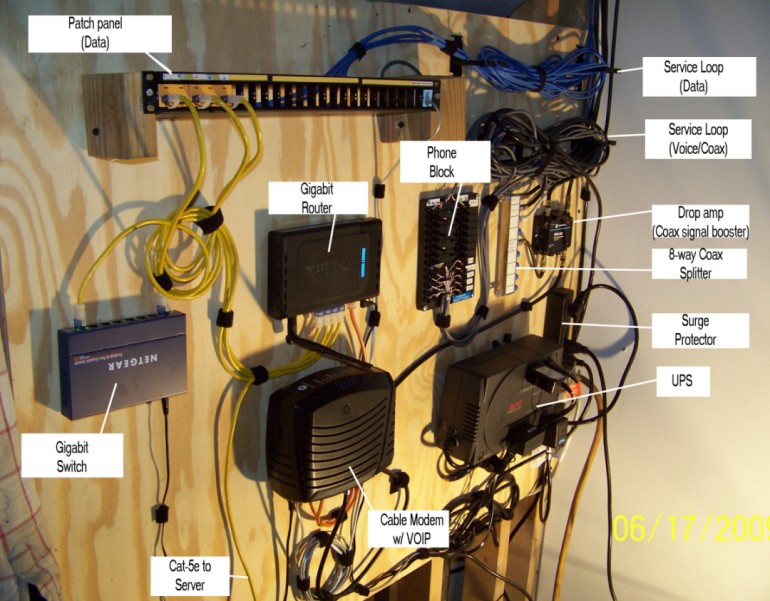
Over on the right is my 8-way coax splitter, and what I labeleld as a "drop amp." The coax comes into the house, into that amp. There is an internal split... one line goes to my cable modem, the other is amplified and sent to my 8-way splitter. I see no signal degradation on any TV (I currently have 4 plugged in to it, but coax splitters don't work like a firehose. If the split exists, you have the approx 3dB degradation whether anything is hooked up, or not. So an 8-way split pretty much needs an amp).
I bought this amp:
http://www.amazon.com/gp/product/B0017I1PVC/ref=ox_ya_oh_product
One month later, no issues.
Rewired a lot of the coax runs with RG6, Quad Shield, which is HD rated and as far as I know the best stuff you can get. I want to say a 500 foot spool cost $60 and Menards... I'm sure I could have gotten cheaper elsewhere, but there I was and there it was. I bought a compression tool and compression fittings for the cable. But of a learning curve, but again, the best method.
Here's my current demarc:
Over on the right is my 8-way coax splitter, and what I labeleld as a "drop amp." The coax comes into the house, into that amp. There is an internal split... one line goes to my cable modem, the other is amplified and sent to my 8-way splitter. I see no signal degradation on any TV (I currently have 4 plugged in to it, but coax splitters don't work like a firehose. If the split exists, you have the approx 3dB degradation whether anything is hooked up, or not. So an 8-way split pretty much needs an amp).
I bought this amp:
http://www.amazon.com/gp/product/B0017I1PVC/ref=ox_ya_oh_product
One month later, no issues.
Rewired a lot of the coax runs with RG6, Quad Shield, which is HD rated and as far as I know the best stuff you can get. I want to say a 500 foot spool cost $60 and Menards... I'm sure I could have gotten cheaper elsewhere, but there I was and there it was. I bought a compression tool and compression fittings for the cable. But of a learning curve, but again, the best method.
"Be bold, and mighty forces will come to your aid."